AI for Startups in 2026: Tools, Costs, and Strategy
Introduction
In 2026, AI has become an integral tool for small-to-mid-sized business (SMB) since it enables SMBs to automate their processes, create better customer experiences, and make quicker decisions than they were able to previously utilizing large teams and financial resources.
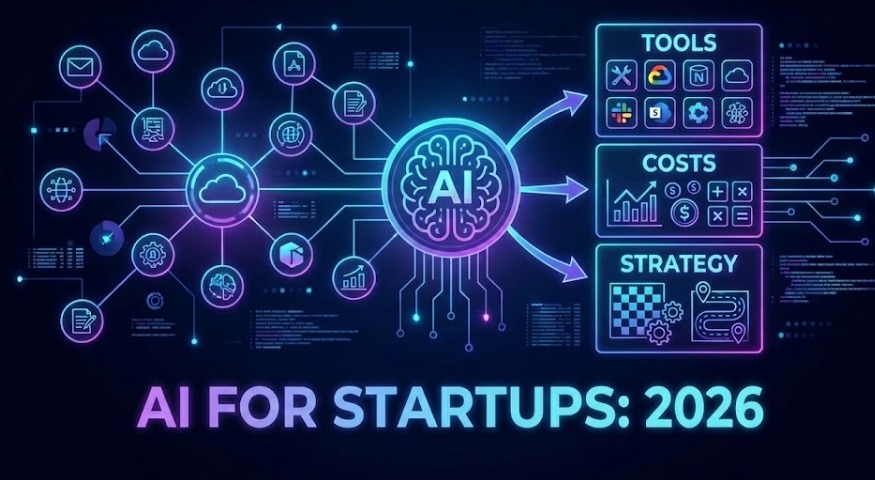
By 2026, SMBs can effectively implement AI through selecting appropriate tools, determining realistic budgetary expectations for leveraging AI, and developing a clear and concise strategy for utilizing the selected tools of AI.
Why AI Is Important for Startups in 2026
The constraints of limited resources, small teams, and high expectations put pressure on a Start-up to perform at a high level regardless of circumstances. Artificial Intelligence (AI) has the potential to provide a solution to these issues by automating processes so that organizations can focus on higher priority tasks, and thus improve overall efficiency.
There are four primary benefits of using artificial intelligence in Start-ups:
1. Automates Mundane, Repetitive Tasks (e.g., report generation).
2. Provides Instantaneous Customer Support (via Chatbots and product recommendations).
3. Provides Predictive Analysis of Business Data (without having to hire a large staff).
4. Provides Greater Overall Productivity for Engineering, Marketing, Sales Departments, etc.
In addition to gaining the above advantages from adopting artificial intelligence technology, by 2026 artificial intelligence will become the standard/baseline requirement to be competitive.
Essential AI Tools for Startups
Small business startups do not need many different AI tools to run their businesses. They just need some basic AI tools that help them solve real world problems.
1) Workflow Automation Software - This type of software allows users to create workflows (i.e. series of actions) and then automate those workflows from within the app. Startups typically use this type of software to automate the transfer of data between different cloud applications as well as triggering notifications and eliminating manual workflows for others.
2) Customer Support Tools - These tools allow companies to provide customer support 24/7 without needing to hire additional staff and can route user questions based on keywords.
3) AI Analytics and Reporting Tools - These types of software provide startups with summarized analytics, risk alerts, and valuable performance metrics without requiring user input to review the data in their dashboards.
4) Online Marketing Assistance Tools - These AI tools enable entrepreneurs to create and post blogs and social media content that are optimized for SEO, while also being able to generate the content in a very short period of time.
How Much Does AI Cost for Startups?
Traditionally, many believe that AI is expensive; however, as of 2026, this misconception has completely changed. To name but a few ways that the AI marketplace has evolved to become cost-effective, usage-based, and accessible for start-ups of all sizes and based on the Future processing the prices are given
Compared to the past where large upfront investments were required for purchase or licensing of majority of the tools, the majority of the new AI tools charge per usage, scale, or the number of features purchased — allowing start-ups to begin with small investments, and increase only when value has been demonstrated through usage.
Realistically, this is how much start-ups can expect to pay for various tools in 2026:
AI Startup Costs in 2026
1. Startups at the Start-up Phase
At this stage the cost of an initial set of systems (An Employee Time Estimation Program) requires monthly service fees from $50-$120/month. These programs will include mild automation with workflow, AI content generator, and analytics. The intent will be for founders and their small teams to validate their business ideas.
2. Startups that are Growing
The customer service, analytics, and automation areas of the startup must all work together to automate the daily operation of the start-up business. Providing these functionalities requires a cost in the $200-$500/month range. It is recommended that start-ups utilize AI chat systems for better customer experiences, provide easy data analysis of their product performance, and also automate their marketing.
3. Startups that Are Borderline Scaling
A company needs to utilize the right advanced systems. These systems include decision based AI based automation and these companies will be requesting large amounts of data on a daily basis. Pricing can vary from $700/month up to $1,500/month or higher depending on your particular company's volume of requests, API calls, and complexity of your models.
A Simple AI Strategy for Startups
Step 1: Identify Bottleneck Activities
Step 2: Automate One Process at First
Step 3: Implement Integrated Tools
Step 4: Evaluate and Optimize Regularly
Common Startup-errors
1) Using too much AI without proper planning/strategy
2) Using poor/ incomplete data
3) Expecting results quickly
4) Not training and allowing staff to utilize AI as needed
AI works best when used as a developmental tool rather than as a stand-alone instant fix
AI is most effective when utilized as part of a continually developing system versus being perceived solely as an immediate solution.
Estimated Future
Artificial Intelligence (AI) will be a mainstay of startup organizations by 2026 as AI will be employed for not only automating processes but also informing decision making, predicting future trends, and analyzing customer behavior. Startups that develop the habit of integrating AI early on are likely to experience accelerated scaling and an improved ability to adapt to changes in their market.
Conclusion
The ability to harness Artificial Intelligence (AI) technologies is possible, affordable and a critical component of becoming successful as a new business in 2026.
Establishing access to the proper equipment, having a good grasp on budget management, and establishing a well-defined road map to follow all provide the opportunity for many new business start-ups to maximise their output from fewer resources.
Beginning with smaller scale AI initiatives whilst keeping in mind the overarching objective will enable an organisation to continue developing into the future.
Building things, learning from them, and writing it down.